

Alongside its monthly grocery industry sales and market share data, NIQ (previously known as NielsenIQ) has revealed that over 50% of British consumers now see price discounts via loyalty cards as the most likely factor to encourage them to buy a product.
NIQ figures covering the four weeks ending 25 March show food inflation soared to 15%, driving up total till value sales by 11.5%, an increase from the 11.1% rise record in February.
Supermarkets in the UK experienced a 7% increase in shopping visits to stores, with a 13% uplift in spend in-store compared to the same time last year. The research group said that this is likely due to many households looking to plan ahead and shop around to save money on their grocery shopping as many continue to be faced with higher monthly household bills.
With this in mind, new NIQ data highlights the importance of loyalty cards for shoppers looking to manage their grocery budgets. 44% of people in a survey agreed that retailer vouchers and coupons are important in determining where they shop – this rises to 55% of those severely impacted by the cost of living crisis.
Moreover, 54% of consumers stated that price discounts via loyalty cards were most likely to encourage them to buy a product. Consequently, a ‘special price discount’ for loyalty card holders is the top response (35%) from UK shoppers when asked which different promotions are likely to influence where they shop. This is followed by an everyday low price as a close second (34%).
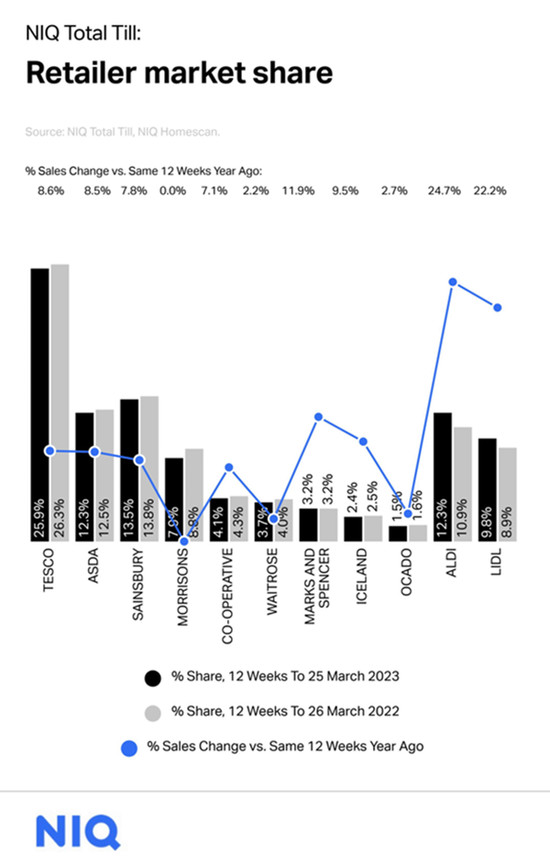
Meanwhile, the NIQ data shows that over the four-week period, volume sales across the grocery multiples fell 3.9%. While this is an improving trend, it still indicates that spend is continuing to shift to the discounter channels, with Aldi and Lidl’s combined growth continuing to be above 20%.
However, M&S experienced good momentum following Valentine’s day and was further helped by Mothering Sunday. Across all grocery channels, shoppers spent £2.8bn in the week ending 18 March – this is £168m more than last Mothering Sunday (+6.4%), with key categories being cut flowers (+5.8%) and chocolate gift boxes (+16.8%) showing that despite the cost of living crisis, there was a willingness to spend more for this event with positive unit growth for both.
“Our recent survey indicates that during a period of high inflation, shoppers are looking for different ways to save money and loyalty card savings are a ‘win-win’ strategy as they reward both shoppers and retailers. They give meaningful savings, shoppers prefer the immediacy of the discount, and they are a promotional mechanic likely to influence where they shop, while also encouraging category purchasing,” said Mike Watkins, NIQ’s UK Head of Retailer and Business Insight.
“Sales should rally this week for Easter (against pre-Easter week last year), and sales at the grocery retailers could top £3bn this week, achieving growth in excess of 20% which will be welcome news for retailers. Over the next four weeks, supermarkets should also be able to maximise the ‘little and often’ purchasing shopping trend over the Bank Holidays in May, which also includes the King’s Coronation weekend.”
Watkins concluded: “Whilst inflation greatly influences shopping behaviour, there is an expectation that we will hit ‘peak inflation’ in the new couple of months. If this happens, the big supermarkets are well placed to fulfil new and different mission-based shopping trips. This is helped by having different store formats, as well as the breadth of ranges, typically not available at a discounter. All of this should help volume sales to eventually return to growth after over a year of decline.”
NAM Implications:
- Rewarding loyal/regular customers at point-of-purchase…
- …can make every little help.
- Until everyone is doing it…
- Then what?


